Posts Tagged ‘chopping boards’

Synthetic Cutting Boards Review

Saturday, March 22nd, 2008

Synthetic cutting board

Characteristic features of synthetic cutting boards…

  • synthetic cutting boards don’t stain easily because of their non-porous surface. Food juices won’t penetrate into them, which will reduce the possibility of bacteria. Some synthetic boards even have an anti-bacterial coating.
  • they are lighter than wooden boards, which makes them easier to work with.
  • you can usually wash synthetic cutting boards in a dish-washer, which is good as far as your board’s hygiene is concerned. (However, the thinner and more flexible synthetic boards may not be strong enough to use in a dish-washer.)
  • they are available in a greater range of colors and shapes, which offers the opportunity to give your kitchen a more modern look.
  • synthetic boards are cheaper than wooden boards.
  • being thinner than wooden boards, synthetic boards are more flexible, which can be useful. For example, you can chop onions and then bend the board to put the onion right into the pan without it scattering out.

Disadvantages…

  • synthetic boards don’t possess the charm of wooden boards.

Click here to view some high quality synthetic cutting boards.

More information about cutting boards can be found in our kitchen cutlery category.

Ganka Vasileva is the owner of http://www.helpful-kitchen-tips.com, a website containing useful information about the kitchen; about the equipment of this greatly-used room in our home that occupies a special place in our lives. Buying guides for kitchen cutlery, small appliances, cookware & bakeware, kitchen furniture, storage & organization, plumbing, etc.

Wooden Cutting Boards Review

Saturday, March 22nd, 2008

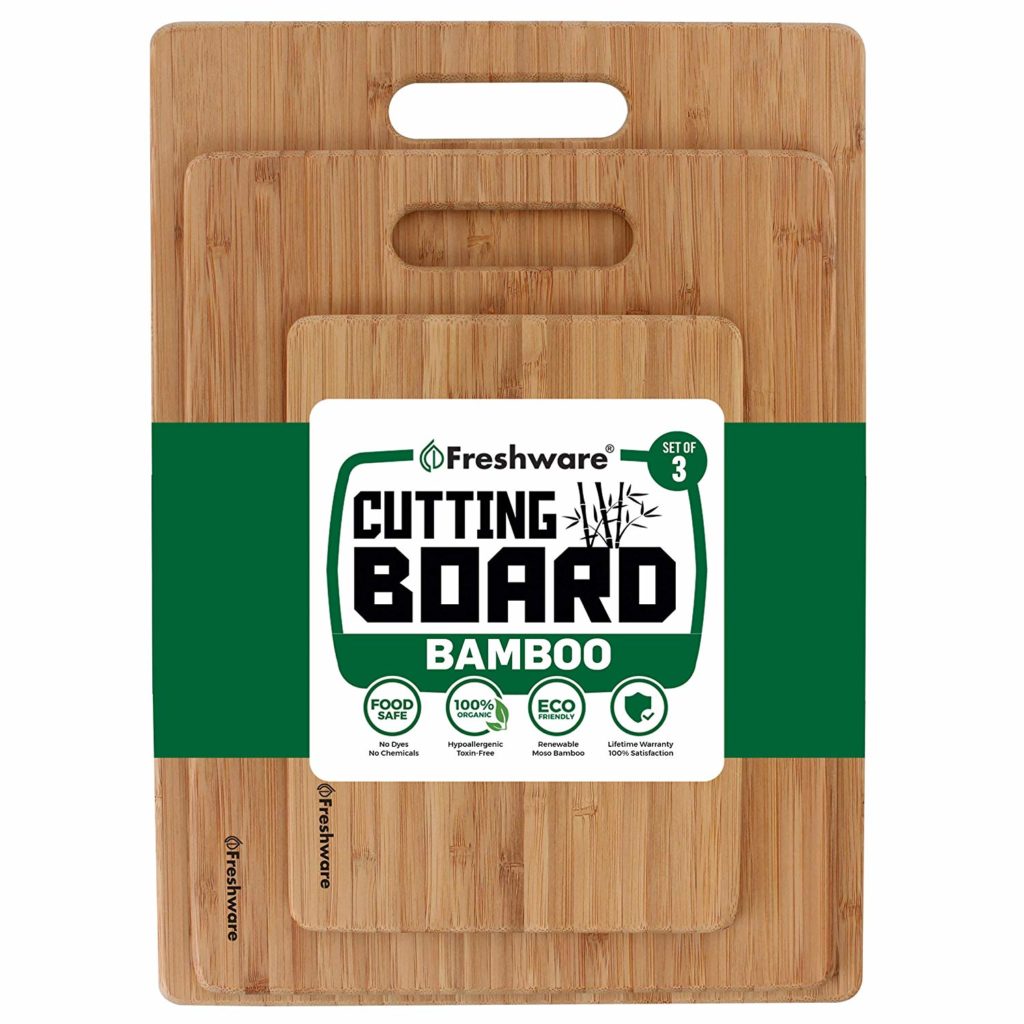
Wooden cutting boards are made from hard wood, such as maple and oak, and from bamboo as well (which is actually a grass). According to the way they are manufactured, wooden boards may be…

End-grain wooden cutting board1. End-grain cutting boards: here, each piece of the board is arranged so that the grain of the wood runs vertically. These cutting boards are of very high quality and look like chess-boards. They are harder and more durable than other wooden boards and are more resistant to knife cuts.

Flat-grain wooden cutting board2. Flat-grain cutting boards: most wooden cutting boards are flat-grain, perhaps because it is easier to make them. Here, the grain of each piece runs horizontally.

Characteristic features of wooden cutting boards…

  • they are visually appealing: this is the classical type of cutting board. Even old, with lots of knife scars on them, these boards look unique. You can bring an accent to the kitchen by leaving a good wooden board on the countertop.
  • they don’t blunt the knife blade as fast as other cutting boards, which are harder.
  • they are strong and durable if you maintain them properly.
  • to a certain extent, knife scars on wooden boards will fade with time.

Disadvantages…

  • hard wood cutting boards are heavy (while bamboo boards are light). That’s why some boards have handles. Handles may be carved in the board, projecting out of it, and may have a rough surface to prevent slippage when your hands are wet. (A heavy board is, however, an advantage when you want to knead bread dough manually or do any other harder task.)
  • wooden boards usually cannot be used in a dish-washer, though some are specially made for such use.
  • they require maintenance if they are to remain in good condition.
  • they are porous, which makes them susceptible to bacteria and odors.

Click here to view some high quality wooden cutting boards.

More information about cutting boards can be found in our kitchen cutlery category.

Ganka Vasileva is the owner of http://www.helpful-kitchen-tips.com, a website containing useful information about the kitchen; about the equipment of this greatly-used room in our home that occupies a special place in our lives. Buying guides for kitchen cutlery, small appliances, cookware & bakeware, kitchen furniture, storage & organization, plumbing, etc.

Kitchen Cutting Boards Review

Tuesday, June 19th, 2007

It will help you to select your cutting boards if you can first prepare answers to questions such as these…

1. How much space do you have on the kitchen countertop?

If you want a large cutting board (for example, 19 to 13 inches (48 to 33 cm)), you must have a place to put it on the countertop. You may also wish to leave the board there after use. Do you have enough free space?

2. How often, and for what purpose, are you going to use the cutting board?

If you are going to use it mainly for little cutting tasks or to serve small amounts of food, there is no point in having a large cutting board.

However, if you are going to cut or chop foods such as raw meat, poultry, fish, etc., a larger board will be more comfortable for you because you will feel more at ease. In addition, a large board is good when serving a greater amount of food, for example a combination of different ingredients…

  • cheese
  • vegetables
  • roasted meat, bread…

3. Will you be able to wash the cutting board easily in the sink?

To wash the board thoroughly and easily, you need to be able to put it into the sink to a certain extent.

Characteristics of kitchen cutting boards

Cutting boards may be rectangular, square, round, oval, and with pleasantly-shaped edges for a better look when serving with them on the table.

Some boards have a rough undersurface, or feet on the underside. Thus the board won’t slip while you use it. The disadvantage here is that you can’t use both sides of the board.

Carving boardSome boards are especially suitable for cutting raw meat (in addition to all the other ingredients, of course). They have grooves on one or both surfaces, whose purpose is to trap the juices of the foods you cut. In addition to the juices not staining the countertop or table, you can use them for the sauce of the meal you are preparing.

Bread slicer with crumb catcherOther boards are suitable mainly for cutting bread, as they are usually boards with slats on a removable tray. When you cut bread, the crumbs fall between the board slats on this tray, without being scattered on the countertop, the table or the floor. Some boards have also guides for cutting slices of the same size.

Over the sink cutting boardYet more boards are designed to fit over the sink. They are ideal in case your kitchen is small and you don’t have enough space on the countertop. Some of these boards have a small colander by one of the ends to wash/rinse the foods you cut, or a bin for the cut ingredients.

Some of kitchen cutting boards come in a package from several boards with different sizes; enough to meet most of your needs for cutting or serving.

Types of kitchen cutting boards

Boards may be divided into two basic types…

  • wooden cutting boards
  • synthetic cutting boards

Wooden cutting boards

These boards are made from hard wood, such as maple and oak, and from bamboo as well (which is actually a grass). According to the way they are manufactured, wooden boards may be…

End-grain cutting board1. End-grain boards: here, each piece of the board is arranged so that the grain of the wood runs vertically. These cutting boards are of very high quality and look like chess-boards. They are harder and more durable than other wooden boards and are more resistant to knife cuts.

Flat-grain cutting board2. Flat-grain boards: most wooden boards are flat-grain, perhaps because it is easier to make them. Here, the grain of each piece runs horizontally.

Read more about wooden cutting boards.

Synthetic cutting boards

Synthetic cutting boardThese boards are lighter than wooden boards, which makes them easier to work with. They are available in a greater range of colors and shapes, which offers the opportunity to give your kitchen a more modern look.

Read more about synthetic cutting boards.

How to look after your kitchen cutting boards

1. Keep your boards clean, whether they be wooden or synthetic. Wash them with hot soap and water after every use. This is especially important if you have just been cutting raw meat, poultry or sea food and you want to use the board for ready-to-eat foods such as vegetables, fruit, cheese, etc.

2. Depending on the usage, disinfect the boards periodically with chlorine bleach. Give the board a preliminary wash, then pour the bleach solution on it and leave it for several minutes. Then, rinse the board with hot water and leave it to dry.

3. Keep your boards dry when you don’t use them, because any bacteria that find their way onto the board will not survive for more than a few hours without moisture.

4. Don’t leave wooden boards to soak in water. They may widen or become soft, or the joints between their composing pieces may weaken.

5. Oil the wooden boards to prevent them from becoming too dry and splitting over time. Apply a layer of food-grade mineral oil to the board surface at regular intervals. Wait several hours until the oil soaks into the board. Oil again if necessary and at the end, wipe off any excess oil. Then wash the board and leave it to dry.

6. Use the entire surface area of the boards when cutting, to ensure even wear. Turn boards that have two cutting surfaces, to wear each surface equally.

7. Don’t chop on the boards crudely, with a big knife such as a cleaver, because you may damage the board’s surface.

8. Change the boards when you see deep grooves or cracks in them. It is more difficult to clean such boards, and bacteria may lodge in the crevices.

Conclusion

It’s a good idea to have several cutting boards to avoid possible cross-contamination. Use one board for raw meat, poultry and fish and another for cooked or ready-to-eat foods such as roasted meat, sausages, vegetables, fruit, bread, etc.

Or use synthetic cutting boards, with a different color for different kinds of food. For example…

  • a red board for raw meat
  • a yellow one for poultry
  • a green one for vegetables

Or use several wooden boards, with different sizes for different types of food. Or just one wooden board, using one side for one type of food and the other side for other types of food.

Ganka Vasileva is the owner of http://www.helpful-kitchen-tips.com, a website containing useful information about the kitchen; about the equipment of this greatly-used room in our home that occupies a special place in our lives. Buying guides for kitchen cutlery, small appliances, cookware & bakeware, kitchen furniture, storage & organization, plumbing, etc.