Posts Tagged ‘honing steel’

Kitchen Knife Sharpening Instructions

Wednesday, April 2nd, 2008

Tips about using a honing steel

To properly realign the edge of your knife, it is best to place the tip of the honing steel on a cutting board or kitchen towel holding the rod vertically. This will give you a vertical line and will prevent slipping.

Hold the knife in your strong hand and place the knife blade at the top of the steel at an angle of approximately 25 degrees. Slowly draw the knife down the length of the steel, pulling the knife back so the entire blade, from base to tip, moves against the steel, as if you were slicing off pieces of the steel. Repeat on the other side. Remember, the secret is to be gentle; don’t push too hard. Do this five to ten times, then rinse the knife off and dry immediately. Make sure you sharpen each side the same number of times to retain the knife’s balance.

Using a honing steel Using a honing steel

It is very important to maintain the angle of approximately 25 degrees and to run the full length of the cutting edge along the steel from the handle to the tip of the knife. Speed of movement plays no part in this process.

In addition, always clean your honing steel before using it. The grooves that run the length of the rod can become clogged with grease and food, which will reduce the effectiveness of the steel. If you can no longer feel the grooves on the steel, it is time to replace it.

Use a steel at least 10 inches long, so that you are able to hone your bigger knives as well.

Tips about using manual and electric knife sharpeners

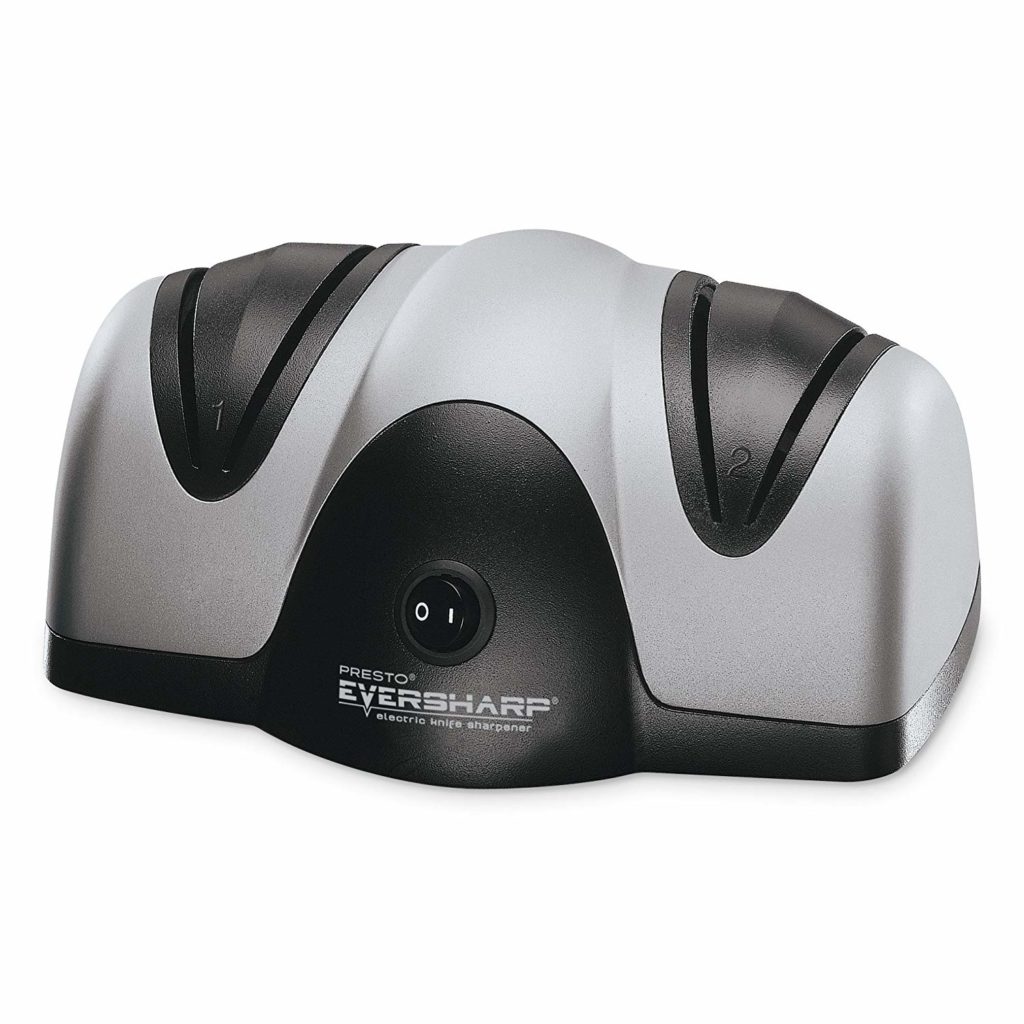
Place the sharpener on a work surface and hold securely with one hand. Draw the knife through the slots with the other hand. Since sharpeners vary drastically, be sure to follow the operating instructions to the letter. If you aren’t careful, electric knife sharpeners can grind away more steel than you may have intended, limiting the life of your knife.

Knife sharpening video

The following video is about Chef’s Choice knife sharpener - one of the top brands on the market. As you will see on the video, it is best to select a sharpener with several slots, angular guides and diamond abrasives. Diamond is very hard, sharpens aggressively and removes metal without upsetting the temper of the knife blade.

Tips about using a sharpening stone

Using a sharpening stonePlace a damp kitchen towel on the countertop and put the stone on top of the towel. This will help prevent the stone from slipping. Grip your knife by the handle with one hand and hold it at an angle of approximately 25 degrees from the stone. Use your free hand to apply even pressure to back of the knife and carefully draw the entire length of the blade over the stone. Turn the knife over and repeat the process. Make sure you maintain the angle of approximately 25 degrees, and always use an equal number of passes for each side. Keep repeating this process until the knife is sharp. When you’re done, carefully rinse the knife off and dry immediately.

To sharpen your knives well, use stones with different grades of coarseness, as with the slots of the sharpeners.

Knife sharpening video

Useful Links:

Ganka Vasileva is the owner of http://www.helpful-kitchen-tips.com, a website containing useful information about the kitchen; about the equipment of this greatly-used room in our home that occupies a special place in our lives. Buying guides for kitchen cutlery, small appliances, cookware & bakeware, kitchen furniture, storage & organization, plumbing, etc.

Calphalon Cutlery - Design, Techniques And Uses

Saturday, March 1st, 2008

Calphalon cutlery 8-inch chef's knife

Useful information about kitchen cutlery from Calphalon. Read the article to learn why forged kitchen knives are a much better option than stamped knives. For example, the blade of a stamped knife is punched out from a thin sheet of steel. Since they are thinner and lighter, stamped knives require that you use a firmer grip and more pressure when chopping, mincing, etc.

Forged knives are handcrafted and represent the highest quality cutlery available. A forged knife always feature a bolster and a tang. A bolster is the center support piece between the blade and the handle. The tang is the portion of the metal enclosed by the handle. Forged kitchen knives are durable, strong and remain sharp for a long time. They won’t stain, rust or add a metallic taste to your food.

After reading this article you will also learn:

  • how to hold a knife correctly
  • how to use a honing steel and why it is the most important tool in a knife block
  • types of kitchen knives, etc.

Please click on the following link to read the whole information. Once there, click on the text that says “Cutlery: Design, Techniques & Uses”.
http://www.calphalon.com/calphalon/consumer/kitchensmart/

More useful information about knives can be found in our kitchen cutlery category.

Ganka Vasileva is the owner of http://www.helpful-kitchen-tips.com, a website containing useful information about the kitchen; about the equipment of this greatly-used room in our home that occupies a special place in our lives. Buying guides for kitchen cutlery, small appliances, cookware & bakeware, kitchen furniture, storage & organization, plumbing, etc.

Knife Sharpeners Review | Sharpening Stone | Electric Knife Sharpener

Wednesday, June 13th, 2007

Different kitchen knife sharpeners are available. For example…

  • a honing steel.
  • a sharpening stone.
  • manual and electric sharpeners.
  • a sharpener attached to a can opener…

To have an effect on the knife blades, these instruments use steel pieces or some of the following abrasives…

  • ceramic.
  • tungsten carbide.
  • diamond.
  • natural or manmade stone…

Whether a sharpener will sharpen your knife, or only keep it sharp for a certain period of time, depends on the way it works.

Characteristics of kitchen knife sharpeners

Honing steel

Honing steelThis is a wonderful tool for keeping your knives sharp. Using it, you don’t sharpen the knife to create a new cutting edge, but just straighten the blade edge, removing a minimum quantity of metal. After a definite period of time (depending on how often you use the knives), the steel will keep your knives sharp no longer, and you’ll have to use some of the instruments for sharpening below.

With a simple ceramic stick, or a stick with a diamond coating, you will sharpen the knife to a certain extent, because these implements are harder then a standard steel rod, but with them you will only prolong the period between sharpening.

You may buy a honing steel either together with a kitchen knife set or separately, and the better ones have a textured or non-slip handle for your comfort. Some also have a magnet that attracts the knife swarves and prevents them from falling on the countertop.

I think that the standard steel rod remains the best choice, because it won’t break if you drop it, as it may occur with the ceramic stick. In addition, with a stick that has a diamond coating, the coating will probably get scrubbed off with time.

Click here to view some high quality honing steels.

Manual and electric knife sharpeners

Electric knife sharpenerBoth types of sharpener (manual and electric) are comparatively easy to use and are a good option for the domestic cook. They usually have guides that help you to hold the knife at the correct angle, thus making its cutting edge symmetrical on both sides.

Manual knife sharpenerAs far as cleaning is concerned, some sharpeners have a magnetic pad that gathers the knife swarves during sharpening, thus making it easier to clean up afterwards. Other sharpeners have rubber feet for greater stability.

To sharpen your knives well, select a sharpener (no matter whether it is manual or electric) with several slots, angular guides and diamond abrasives if possible. Diamond is very hard, sharpens aggressively and removes metal without upsetting the temper of the knife blade.

As you use the various sharpener slots, you will perform the following processes…

  • in the first slot you will remove the greatest quantity of metal from the knife, creating a cutting edge and removing any damaged parts of the blade.
  • in the second slot you can form the cutting edge more precisely.
  • in the third slot you will polish the blade edge and at the finish, your knife will have a strong and durable cutting edge.

If the sharpener has only one slot, as has, for example, a sharpener attached to a can opener, it may be too coarse, taking too much metal away from your knife during sharpening. This will shorten the life of your knife and may damage the blade by upsetting its temper. On the other hand, if the sharpener with one slot is too fine, it will take longer to sharpen your knives; or you might not sharpen them at all, but just hone them as with the honing steel.

Another disadvantage of manual and electrical knife sharpeners is the inability of some of them to let you sharpen the knife blade along its whole length or to sharpen a serrated blade. Other sharpeners are good only for a particular knife brand or aren’t suitable for a knife with a cutting edge only on one side of the blade. A third type of sharpener isn’t appropriate for ceramic knives, and some manual sharpeners are only for right-handed people.

Click here to view some high quality manual and electrical knife sharpeners.

Sharpening stone

Sharpening stoneWith stone you can sharpen the whole blade of your knife, thus keeping its original shape. You can also sharpen some more specialized instruments, such as kitchen scissors, cleavers, mincing knives, etc.

To sharpen the knives well, use stones with different grades of coarseness, as with the slots of the sharpeners. That is to say…

  • a rough grit stone to create a cutting edge on the blade.
  • a medium grit stone to form this edge more precisely.
  • a fine-grit stone to polish the blade edge.

Another good variant is to use one stone with two grits; rough on one side and fine on the other, with different colors so that you can distinguish between them.

When using a stone, you have to be experienced enough to hold the knife at the correct angle, because otherwise you may spoil its cutting edge. In addition, you have to lubricate some stones with mineral oil or water before sharpening. Thus, you will prevent the knife swarves from filling the stone and impeding its ability to sharpen. (The coating you have to use depends on the type of stone and is usually written in the operating instructions. Nevertheless, it’s a good idea to clean your sharpening stone periodically with a brush.)

Click here to view some high quality sharpening stones.

Conclusion

1. If you want a manual or electric sharpener, be sure that it will be able to sharpen the knives you use and, if it is a manual one, that it will fit the hand you usually work with.

2. If you want a sharpening stone, think about whether you are experienced enough to use it properly.

3. No matter what kind of kitchen knife sharpeners you choose, always use a honing steel to keep the blades sharp in the period from one sharpening to another. Use a steel at least 10 inches long, so that you can hone your bigger knives as well.

Ganka Vasileva is the owner of http://www.helpful-kitchen-tips.com, a website containing useful information about the kitchen; about the equipment of this greatly-used room in our home that occupies a special place in our lives. Buying guides for kitchen cutlery, small appliances, cookware & bakeware, kitchen furniture, storage & organization, plumbing, etc.