Posts Tagged ‘kitchen decorating’

Kitchen Backsplash Ideas

Wednesday, April 23rd, 2008

Kitchen backsplash

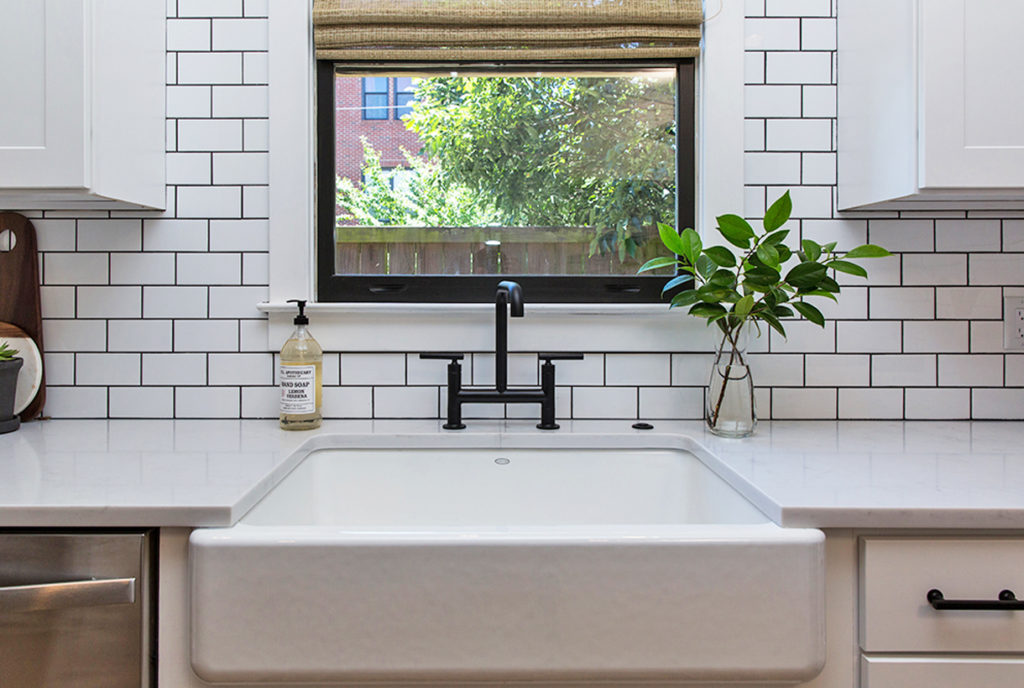
The kitchen backsplash is placed on the kitchen wall between the countertops and the wall cabinets. It protects the walls and especially the zones behind the range, the sink, and the places where you prepare the food, from staining. Your backsplash will stain, but the materials appropriate for it are usually easy to clean and maintain and are a far better option than just a bare painted wall or wallpaper.The kitchen backsplash also has aesthetic value. With colors, patterns or textures appropriate for a backsplash you can improve the visual appeal of your kitchen, without difficulty and at a reasonable price.

Some backsplashes are only about 4 inches (10 cm) high and are usually a continuation of the countertop. These are not effective, because if you don’t cover the entire area up to the wall cabinets with a backsplash, significant parts of the wall will remain unprotected. With a standard backsplash, about 18 inches (46 cm) high, you will cover the whole area between the countertops and the wall cabinets and you will give your kitchen a finished look.

You might place your backsplash only behind detached zones in your kitchen, such as the range and the sink, thereby attracting attention to them; but a better option is to place a backsplash along the whole length of the room, thus achieving a unified look.

Kitchen backsplash materials

The following materials are popular variants for a kitchen backsplash. Many of them are used for kitchen countertops as well, which means that your backsplash and countertops can be made of one and the same material. The materials are strong, durable and usually easy to clean and maintain. I say usually, because some tiles, stone or metal may require periodic maintenance (sealing or polishing), according to the manufacturer’s instructions.

1. Ceramic and porcelain tiles: these tiles exist in various colors, patterns and textures and may imitate natural stone as well.

2. Metal and metal laminate: with a backsplash from a stainless steel sheet you will give your kitchen a modern and simple look. Besides, its neutral color matches most other colors.

You may use others metals as well, such as copper, zinc, tin, brass or nickel. Some of the metals will change their look with time if you don’t maintain them, and this effect may appeal to you.

As a cheaper variant you may use metal laminate. This is similar to plastic laminate, but is covered with a metal layer.

3. Natural stone: an exceptionally fine material with a unique pattern for each of its layers, making your backsplash different from that of anybody else. It is also extremely durable.

You may use various kinds of stone. For example granite, marble or limestone.

4. Solid surface: synthetic material, existing in variety of colors, patterns and textures. It may also imitate natural stone.

5. Glass: with a backsplash from glass sheets you will, again, give your kitchen a modern and simple look. And, if you have beautiful pictures on the wall, they can still be seen through the glass, while being protected from damage.

Some other, not so traditional, materials for backsplashes exist as well, such as cork, but they are used more rarely or have yet to gain popularity.

Cork, in particular, is a naturally textured soft material. You may pin notes and recipes on it, but I think it’s not very appropriate for the key zones in the kitchen, such as the range and the sink, because you will find it difficult to clean.

Kitchen backsplash design

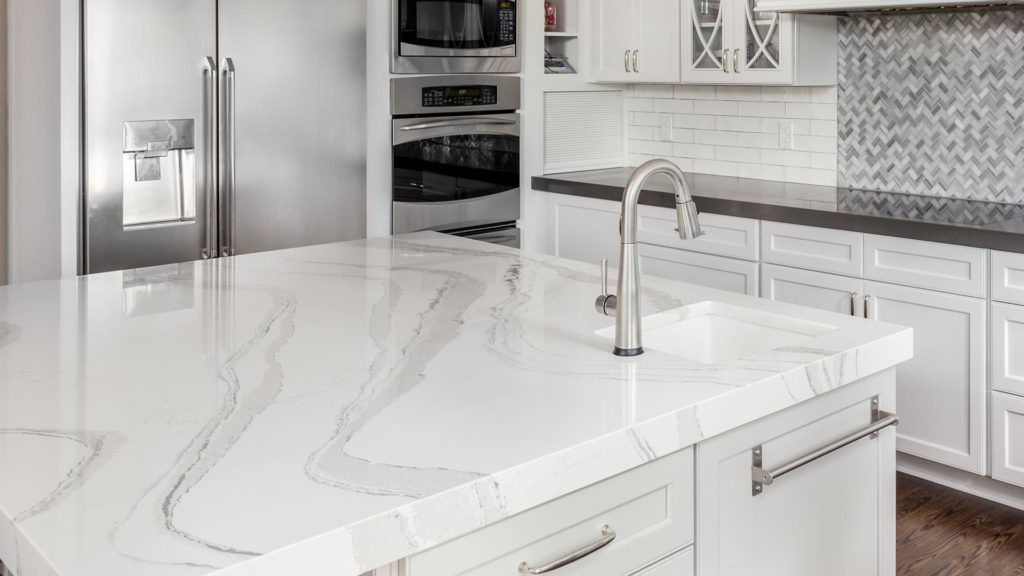
If you want a simple look, select a backsplash with the same design as your countertop.

If you are looking for a more vivid effect, select patterned tiles. For example, you could use square tiles, set on a diagonal in contrasting colors, like a checkerboard.

Square tiles, set on a diagonal in contrasting colors, like a checkerboard

If you have a small kitchen, choose a mirrored backsplash or one with a large pattern. For example, you could use several small accent tiles in combination with large tiles with a simple design. In this way, you will make your room look bigger.

Small accent tiles in combination with large tiles with a simple design

Small accent tiles in combination with large tiles with a simple design

If you want more light on the work surfaces, such as the range, the sink and the countertops, select a light backsplash, because light tones and shiny surfaces reflect the light well.

Since the backsplash is between the countertops and the wall cabinets, it is a good idea for it to match both the colors and the textures of the countertops or wall cabinets, with color being the more important. As far as the shape of the backsplash is concerned, some of the materials above, in addition to standard tiles, also exist as sheets. With sheets there won’t be gaps that have to be filled with grout and this means that you will be able to clean the backsplash more easily. (The grout, which fills the gaps between tiles, gathers dirt with time and requires periodic cleaning.)

If you select standard tiles, allow the larger ones to predominate over any smaller ones, because then there will be fewer gaps to fill with grout, and so less to clean. As far as the grout is concerned, the darker its color, the less the dirt on it will be visible.

Price of kitchen backsplash

The price of your backsplash will be determined by such factors as…

  • the size of the area that the backsplash covers.
  • the material used.
  • the design.

In general, a backsplash made of ceramic or porcelain tiles will be cheaper than one made of stone or metal. However, if you have your tiles custom-made, they might be very expensive.

Kitchen backsplash installation

To be sure of the quality of your kitchen backsplash installation, I recommend that you employ the services of a professional. Click here to submit your project and receive free estimates from highly rated local, licensed contractors within 48 hours with no obligation.

Ganka Vasileva is the owner of http://www.helpful-kitchen-tips.com, a website containing useful information about the kitchen; about the equipment of this greatly-used room in our home that occupies a special place in our lives. Buying guides for kitchen cutlery, small appliances, cookware & bakeware, kitchen furniture, storage & organization, plumbing, etc.

Other resources: Granite backsplash installation video

Kitchen Rugs : Functionality And Aesthetics

Wednesday, July 18th, 2007

Kitchen rug

With kitchen rugs you can…

  • bring warmth, color and a cheerful mood to your kitchen.
  • hide old flaws, if you have any, on the kitchen flooring.
  • revivify the flooring, if you think it isn’t attractive enough.
  • keep the flooring in good condition, protecting it from damages and stains.
  • prevent, to some extent, dropped objects from breaking.
  • make your work in the kitchen more pleasant, feeling their warmth and softness under your feet…

However the kitchen is a special room in our home. For that reason the kitchen rugs must be multi-functional. They must possess certain properties that other rugs don’t usually have. The tips that follow are based on these properties. Upon reading them, you’ll know what rugs to put in front of the key zones of your kitchen, for example…

  • in front of the sink
  • in front of the range
  • in front of the countertop
  • in front of the refrigerator

What properties must kitchen rugs possess

1. Look for kitchen rugs that have the ability to withstand intensive usage.

The kitchen is usually a high-traffic region, being one of the most frequently used rooms.

2. Kitchen rugs must also have the ability to resist water and moisture.

It’s normal that there be more moisture in your kitchen than in other rooms, because of cooking and washing.

3. An important thing for safety in your home is that your kitchen rugs can withstand high temperatures (or, at least, to have a high ignition temperature).

We all have accidents. Sometimes we might spill hot water or food on the floor while cooking, or drop hot utensils…

4. You have to be able to clean your rugs comparatively easily, so it’s best if they are machine-washable.

It’s normal if stains appear on your flooring (on the rugs as well) in the kitchen while cooking or washing. (If your kitchen has an exterior entrance, your rugs will become soiled even more quickly.)

If you place machine-washable rugs in front of your sink, range or refrigerator, you will be able to use them again and again, without them becoming dirty or dingy.

5. The kitchen rugs must be thick. The thickness refers to the amount of the threads and how tightly they are interwoven. It will be best if the threads are short ones, because then the rug will have a tighter weave.

6. Use kitchen rugs with a non-slip pad underneath, between the rugs and the flooring; or with a non-slip backing on their underside. Then, your rug will be stable and it will be much less likely that you will slip on it.

Using a non-slip pad you will also…

  • prolong the life of your rug, letting its fabrics breathe.
  • avoid pressing the rug to the flooring, resulting from the exhaustion of its pile after long-term usage.
  • clean your rug more easily with a vacuum cleaner.
  • protect your kitchen flooring from scratching, if it has a smooth surface.

The material used for these pads is usually polyurethane, polyester or rubber.

The pad is an accessory, and is thus sold separately from your rug. Usually the characteristics of the pad and the kitchen rug itself are stated by their manufacturers on the label, or in a pamphlet.

Materials for kitchen rugs

Look for rugs, made from some of the following materials…

  • wool
  • nylon
  • polypropylene (olefin)

These materials are…

  • strong and durable
  • resistant to water and stains (they repel liquids)
  • easy to clean and maintain
  • resistant to high traffic and moisture (although wool absorbs moisture)

Wool is a soft, luxurious and natural material (it is like a gold standard against which all other materials are measured). It resists fire well and dampens noise well. Together with nylon, you can find them in different colors.

Kitchen rugs design

You can find rugs with different shapes…

  • rectangular
  • square
  • round, oval…

With different colors and designs…

  • solid color
  • representing different geometrical figures
  • different foods, plants, animals, drinks…

With different styles…

  • contemporary
  • traditional
  • transitional…

Choose the design of your kitchen rugs so that they complement the general appearance of the kitchen. If your kitchen (the flooring, the walls, the furnishing inside…) already has sufficient pattern, it may be best to use solid-color kitchen rugs. However if clean, deep colors predominate, patterned rugs will introduce an element of vitality. Thus you will avoid the overuse of different colors and will maintain the beauty of the rugs and their influence over the decor of your kitchen.

Conclusion

It is important to choose appropriate kitchen rugs. Consider well the tips above. Think about the way you use your kitchen and the way you might use it in the future.

Ganka Vasileva is the owner of http://www.helpful-kitchen-tips.com, a website containing useful information about the kitchen; about the equipment of this greatly-used room in our home that occupies a special place in our lives. Buying guides for kitchen cutlery, small appliances, cookware & bakeware, kitchen furniture, storage & organization, plumbing, etc.